


He was born in Venice on June 22, 1976. In 1995, he graduated from the Marco Polo High School in Venice. In 2002, he earned a Bachelor of Arts degree from Ca’ Foscari University of Venice. In 2006, he earned a PhD in Christian Literature (Late Antique and Early Medieval Civilization) from the University of Bari, now named after Aldo Moro. From 2013 to 2015, he taught Latin at Ca’ Foscari University in Venice. In 2002, he earned his bachelor’s degree with a thesis dedicated to a Latin historical work by Giambattista Vico (De Neapolitanorum Principum coniuratione anni 1701 historia), with the aim of investigating the extent to which Tacitus had influenced a modern author, both in style and in the depth of thought. In 2006, to earn his Ph.D., he defended a dissertation on the fifth book of Avitus of Vienne’s Historia Spiritalis. He commented on nearly every verse of the poem, highlighting numerous parallel passages and accompanying them with explanatory notes. Of particular interest was understanding the extent to which Augustine of Hippo, who introduced figurative exegesis into his writings, had influenced Avitus of Vienne. Indeed, one must not forget that Avitus is often described by many scholars as an Augustinian poet. At the conclusion of the research, this view could not be dismissed, given the conviction that poetic works of this kind can never be fully understood unless they are regarded as tools for explaining the Christian faith rather than mere literary exercises. This led to a growing interest in the history of biblical exegesis. Deeply rooted in the Catholic faith, he believes that Christianity was established by divine providence precisely as Greek and Latin culture and civilization were flourishing. His interest in the history of biblical exegesis led him to devote himself to the study of the Jesuits. Shortly after earning his Ph.D., he turned his attention to Jesuit tragedies, especially those drawn from the Holy Scriptures, seeking in their composition the so-called figurative exegesis. Noting that the members of the Society of Jesus had adopted only literal exegesis, he nevertheless continued to devote himself to these studies, eager to verify the extent to which the tragic works of Seneca had influenced the Jesuits. For several years he devoted himself intensely to these issues, moving to the University of Leuven where, thanks to a very rich library, he was able to further deepen this research. Upon returning to his homeland, he worked for two years at the University of Venice. Among the tasks entrusted to him is that of transcribing and compiling into a single corpus the Latin poems that served as prefaces to printed books, from the era of incunabula through the early 18th century. See the following website where they are available: http://mizar.unive.it/poetiditalia/public/indici/carminalibraria From late 2016 through April 2019, he devoted himself to writing a book on epic poetry developed between the 16th and 18th centuries, under the auspices of the publishing house Il Mulino. His interests include both Byzantine Greek literature and modern and contemporary Greek literature; for some time now, he has also been reading novels written in English in their original language. He is convinced that Latin grammar, the Latin language, and Latin literature—having served as a model for numerous writers from various nations who, in past centuries, composed works in their own vernacular languages—can never be forgotten. For this reason, he believes that the study of Latin must always be promoted; otherwise, European culture and civilization would risk falling into decline. Furthermore, he loves music so deeply that he has composed several musical works himself, set Latin texts to music, and directed their performances. He is studying composition at a music institute.
Books by this author
-
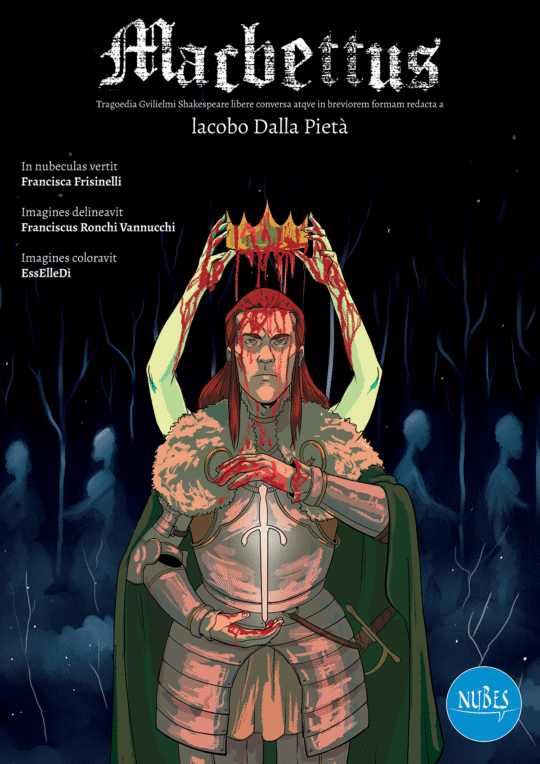
Macbettus
18,00 €
 English
  Italiano
  Latine